
Moran Town, Assam, gets its name from a market. “Moran” is a shortened form of “Moran-hat,” a trading place where members of the Moran community came to sell their goods. That market town has grown into a key centre of Upper Assam’s oil and tea economy, sitting on one of the region’s longest-producing oilfields.
It also shares an unusual quirk with its neighbour: Moran Town is the Dibrugarh district side of a settlement that the national highway splits between two districts. Here’s what Moran is, how its oil story unfolded, and how to get there.
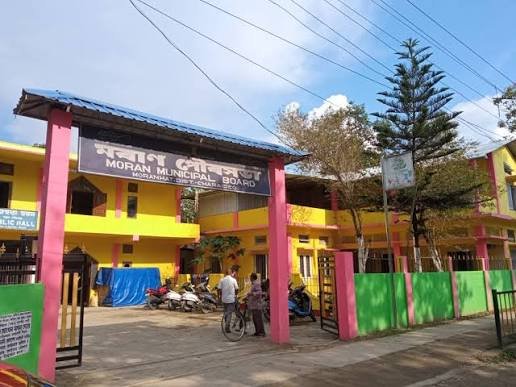
Moran Town at a Glance
| Detail | Information |
| District | Dibrugarh, Assam |
| Name origin | Short for “Moran-hat” (Moran market) |
| Population (2011) | 8,784 |
| Elevation | About 97 m |
| Known for | Oil and tea |
| Oilfield | Moran–Hugrijan |
| Assembly seat | Moran |
| Lok Sabha seat | Dibrugarh |
| Location | About 40 km south-west of Naharkatia |
| Neighbour | Moranhat (Charaideo district side, across NH 37) |
One Settlement, Two Districts
NH 37 runs through the middle of the settlement:
- Moran Town: The side in Dibrugarh district.
- Moranhat: The side in Charaideo district, which was carved out of Sivasagar district.
- Practical tip: Government offices, land records and police jurisdiction depend on which side of the highway you’re on.
A Population Figure That Doesn’t Add Up
Wikipedia’s Moranhat page lists a 2011 population of 1,54,296, which is exactly the same figure given for Dibrugarh city. It’s almost certainly a copying error. For Moran Town, the 2011 figure of 8,784 is the reliable number, and Moranhat’s own 2001 figure was 5,779.
The Oil Story
- Discovery: Several sources say oil was found in the Moran–Hugrijan field in 1953, with production starting in 1956. Another source dates the Moran discovery itself to 1956, so the dates vary depending on whether they refer to discovery or first production.
- Depth: Drilling found oil in the Barail formation at a depth of about 3,355 metres.
- Scale: Older estimates put Moran’s potential at about one million tonnes a year, from around 20 wells producing oil and gas. These figures are dated, and current output is likely different.
- Oil India’s origins: The Moran and Nahorkatiya discoveries led directly to the creation of Oil India Limited.
- Today: Duliajan, Dikom, Tengakhat and Moran remain key centres of Dibrugarh district’s oil and gas industry.
Tea Country
Moran is also a major tea-growing area. Dibrugarh district as a whole has one of the world’s largest areas under tea, and many of its gardens are more than 100 years old. Tea estates surround the town, and many residents work in the tea industry.
Getting to Moran Town, Assam
By Road
- NH 37: Runs through the town and connects Moran to Dibrugarh, Sivasagar and Jorhat.
- Dibrugarh: About 40 km away by road.
- Naharkatia: About 40 km north-east, via the Naharkatia–Moran road through Tingkhong.
By Rail
The railway station is on the Moranhat (Charaideo) side, on the line to Dibrugarh. For long-distance trains, Dibrugarh and Simaluguri Junction have more options.
By Air
Dibrugarh’s Mohanbari airport is the nearest, with flights to Guwahati, Kolkata, Delhi and other cities.
Nearby Areas
Naharkatia
About 40 km north-east, where India’s first major post-independence oil discovery was made in 1953. Duliajan, Oil India’s field headquarters, was once part of Naharkatia’s revenue circle.
Tingkhong
A tea and oil town on the Naharkatia–Moran road, known for its tea estates.
Duliajan
The field headquarters of Oil India Limited, about 50 km from Dibrugarh city.
Namrup
An industrial town known for the Brahmaputra Valley Fertilizer Corporation, Assam Petrochemicals and the Namrup Thermal Power Station.
Digboi
Home to what’s described as the world’s oldest running oil refinery, in neighbouring Tinsukia district.
Charaideo and Sivasagar
Across the highway, Charaideo district leads to the UNESCO-listed Ahom burial mounds at Charaideo. Sivasagar, the former Ahom capital, is also within easy reach.
FAQs
Q1. How did Moran Town get its name?
A: “Moran” is short for “Moran-hat,” a market where members of the Moran community came to sell their goods.
Q2. What is the difference between Moran Town and Moranhat?
A: They’re two sides of the same settlement, split by NH 37. Moran Town is in Dibrugarh district, and Moranhat is in Charaideo district.
Q3. When was oil discovered at Moran?
A: Most sources say oil was found in the Moran–Hugrijan field in 1953, with production starting in 1956. One source dates the discovery itself to 1956.